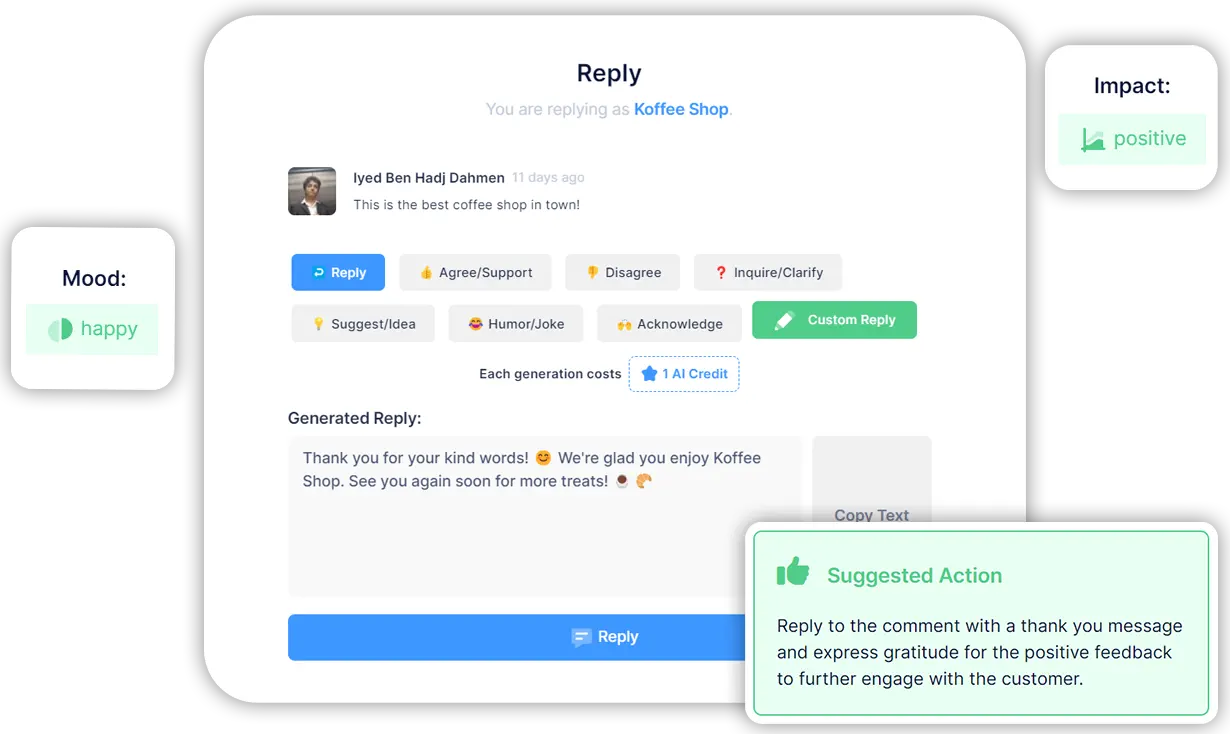




OutReply scores the mood of the comments people leave on your Facebook, Instagram, YouTube and X posts, then shows the trend: what lifts the mood, what drags it down and who is behind it.
Sentiment also shapes the reply. Comments in the review queue show the commenter's mood and likely business impact, and a workflow can route complaints to a person.
Comments on your Facebook, Instagram and YouTube posts are collected in the background, and X comments are added as you open posts in OutReply. Mentions found by Reddit monitoring carry their own sentiment label. TikTok comments aren't included, because OutReply doesn't read them.
Scoring runs in batches every ten minutes on OutReply's own servers, so it doesn't use credits and no comment is sent to a third-party AI just to be labelled.
A rules-and-lexicon model built for social media. It understands emoji, ALL CAPS, repeated exclamation marks, negation such as "not bad" and "but" contrasts.
Advanced and Elite use a multilingual transformer tuned on social media posts, which reads comments in many languages. After upgrading, you can re-score comments that were labelled by VADER.
In the review queue, OutReply can read an unanswered comment and label the commenter's mood (from frustrated or confused to happy or excited), its likely impact on your business and a suggested next step. In DMs, the AI sidekick reads the conversation and reports the customer's mood, key topics and a recommended approach for one credit.
Third time my order has arrived late. Not impressed.
Mood: frustrated. Impact: negative. Suggested action: apologise and move the conversation to DMs.
Obsessed with the new menu!! 🔥🔥
Mood: excited. Impact: very positive. Suggested action: thank them and invite them back.
To act on it automatically, add an AI condition such as "Is this comment a complaint?" to a workflow, or hide abusive comments with comment moderation.
Each comment gets a positive, neutral or negative label and a score between -1 and 1. Free brands are scored with VADER, a lexicon model built for social media; Advanced and Elite use a multilingual neural model. Both run on OutReply's servers.
Facebook, Instagram and YouTube comments are collected automatically, X comments as you view them in OutReply, and Reddit mentions through Reddit monitoring. TikTok comments aren't included because OutReply doesn't read them.
No. Comments are scored in batches every ten minutes at no credit cost. The AI analysis of a DM conversation costs one credit per run.
Free shows the overall mood split of your audience and a capped list of commenters. Mood over time, pain points, topic insights and per-person timelines are part of Advanced and Elite.
Connect your accounts on the Free plan and see the mood split of your comments.